
From Childhood, It Was Never My Choice Zarin tells me that hijab was never optional for her, neither at school nor outside it. Even inside the classroom, she says, removing it was not allowed. “If you are tired, you still cannot take it off,” she explains. “It is considered a crime.” As she speaks, she returns again and again to the same question—one she has carried since childhood. “Why should I wear hijab? Why am I forced to wear it? Why should the law decide this for me?” She says she was only nine years old when she was told to cover her hair. Over time, the rules reached even into her home. Choice was never part of the conversation. For Zarin, hijab was not about belief or personal decision. It was about law and punishment. “The law tells you to wear it,” she says. “If you act against the law, there will be so much trouble.” Girls who did not follow hijab rules could be arrested. Police would write fines. If the fines were not paid, prison was the next step. Enforcement was everywhere. Zarin describes police units set up across the city to check women’s clothing. She remembers one moment clearly. “They grabbed me and put me in a van,” she says. “They told me to button my clothes.” She insists her clothes were not improper, but that did not matter. After warning her, they released her—only because they could not find another reason to keep her. Because of experiences like this, fear became part of her daily routine. Going outside required planning. She chose long clothes, layered outfits, and headscarves that fully covered her hair. “Even if I wore tight jeans,” she says, “I had to wear something long over them.” This fear followed her everywhere—even to the grocery store. “Before going out, I always checked my clothes,” she tells me. “Someone might pass by, and it could be the police.” The fear did not only come from authorities. She says ordinary people with strong religious views also harassed women verbally. “These fears were always with me,” she says. “And with all Iranian women.” Then came the protests.
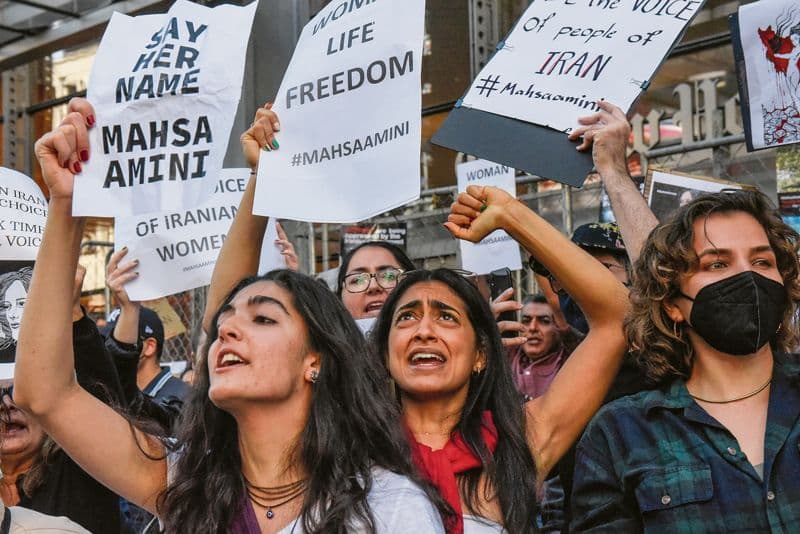
Zarin remembers how the women’s movement began after the death of Mahsa Amini (Zhina). What started as grief turned into resistance. The slogan Women, Life, Freedom became a symbol of opposition to compulsory hijab and the Islamic regime. For Zarin, it felt like a moment of possible change. She decided to take part.
What she remembers most clearly is the violence. “They were hitting everyone,” she says. Tear gas filled the streets. Batons came down on protesters. Guns were used. Sometimes she joined the protests again and again. Other times, she turned back. “They were shooting ordinary people,” she says quietly. “Like they were not human.” Many people were killed. Many others were seriously injured—some losing parts of their bodies. After attending the protests, Zarin became a target. “They filed a case against me,” she says. She was accused of being anti-Islam, a troublemaker, and anti-hijab. One day, a court warrant arrived at her family’s door. She was given ten days to report to court. She went. At the court, she was given two options: pay a fine of 100 million Iranian rials or go to prison. Her family paid the fine to secure her release. “It was a huge amount for my family,” she says. Even after that, the punishment did not end. Zarin was banned from leaving Iran for years. She was forced to follow strict instructions in order to continue living inside the country. As she finishes her story, one thing becomes clear: for Zarin, hijab was never just a piece of cloth. It shaped her childhood, controlled her movements, and placed her in danger. From the age of nine, her body became a site of law, fear, and resistance. And still, she speaks—not just for herself, but for many Iranian women whose stories remain unheard. Her name has been changed for safety.