Understanding Honor Killing as a System, Not an Exception
In patriarchal societies, women are not expected to have views. If they do, those views are dismissed, punished, or silenced. A woman speaking becomes a threat — not because she is wrong, but because she exposes imbalance.
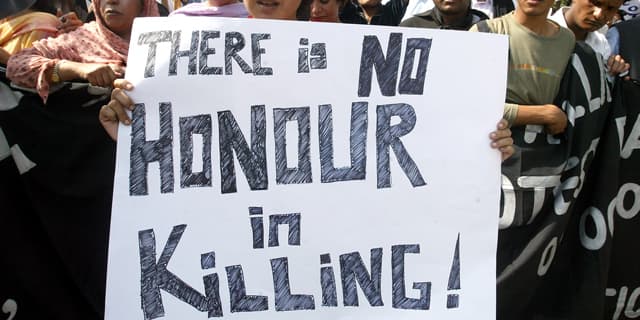
honor-killing-protest.jpg
Understanding Honor Killing as a System, Not an Exception
Asra Ansari is thirty years old and holds a master’s degree in psychology. She speaks not only as an academic, but as a woman who grew up inside the social structures she analyzes. For her, honor killing is not an isolated crime, nor a moment of sudden violence. It is a name — a justification — created within male-dominated societies to normalize control over women’s lives.
In Pakistan, she explains, “honor” is rarely discussed without attaching it to women. Dishonor is imagined as something a woman creates — by speaking, choosing, refusing, or simply existing outside prescribed boundaries. When a woman is believed to have crossed those boundaries, men claim the right to punish her. This punishment, Asra says, is framed as culture, tradition, or family values — but at its core, it is about power.
Honor killing, in this sense, is not about morality. It is about enforcement.
Asra Ansari, Psychologist
Asra situates Pakistan within a broader regional pattern. Similar structures exist in Afghanistan, Nepal, and across South Asia, where patriarchy is deeply embedded in social, legal, and familial systems. Men decide what is acceptable for women, and those decisions slowly become normalized as tradition. Over time, these norms are no longer questioned — they are inherited.
From childhood, gender roles are carefully taught. Girls are instructed to stay inside, cook, care for family members, and prioritize obedience. Boys are taught that they are providers, decision-makers, and leaders. Rarely is a girl told she can be more than a homemaker. Rarely is a boy taught to listen.
When women speak — especially when they speak about injustice — they are seen as disruptive. A woman who is opinionated, educated, or vocal challenges the hierarchy men were raised to believe is natural. Asra explains that this is where honor violence often begins: not when a woman disobeys, but when she questions.
In patriarchal societies, women are not expected to have views. If they do, those views are dismissed, punished, or silenced. A woman speaking becomes a threat — not because she is wrong, but because she exposes imbalance.
Asra points out that leadership is gendered in deeply ingrained ways. Men are assumed to lead families simply by virtue of being male. When a woman is left alone — through death, divorce, or abandonment — she is rarely respected as a legitimate head of household. Her authority is questioned, her competence doubted. The system does not train men to accept women as leaders; it trains them to resist it.
Even language reflects this imbalance. In everyday speech, insults are feminized. Abuse is associated with women’s names and bodies. Masculinity is protected; femininity is blamed. This linguistic training reinforces the idea that women are weaker, inferior, and responsible for maintaining honor.
Asra explains that this is not accidental. It is learned behavior — passed down within families, schools, and communities. Boys are told not to be emotional. Girls are told not to be assertive. Any deviation from these roles is punished socially, and sometimes violently.
In marriages, this imbalance becomes more visible. If a woman earns more than her husband, her success is often resented. If she is more educated, her knowledge is perceived as threatening. Patriarchy does not allow flexibility — it does not permit role reversal, even when necessary. Men are not taught to adapt; women are taught to shrink.
Honor killing, Asra says, is often justified through this imbalance of power. Men present narratives to courts and communities — that a woman violated family values, disrespected norms, or damaged reputation. These explanations are accepted because society already assumes women are wrong. Men are rarely held accountable.
The legal system, she argues, reflects the same hierarchy. Laws exist on paper, but implementation is selective. Justice often depends on class, wealth, and gender. Men with money can manipulate systems, influence outcomes, and escape punishment. Women without resources are silenced.
Asra emphasizes that the problem is not only legal failure, but societal acceptance. When communities excuse violence as honor, perpetrators feel validated. They believe the system will protect them — and often, it does.
Media, she notes, plays a powerful role. In some cases, it reinforces harmful narratives. In others, it exposes injustice and pressures institutions to act. The murder of Sana Yousuf, shot inside her own home after rejecting a proposal, is one such case. Sana exercised a basic human right — to say no. The violence that followed was rooted not in love or tradition, but in wounded male ego.
Public attention forced accountability. Without it, Asra believes, the case may have been ignored — like so many others.
Asra speaks about patriarchal attitudes in Pakistan
For Asra, honor killing cannot be reduced through symbolic laws alone. Punishment must be enforced, consistently and publicly. Accountability must be real. But more importantly, education must shift focus. Too often, society teaches women how to behave — how to dress, speak, obey. Men are rarely taught restraint, respect, or responsibility.
Gender education, she argues, must address both sides. Boys must be taught that leadership does not mean control, and masculinity does not mean dominance. Girls must be taught that their value extends beyond obedience.
Honor killing, Asra insists, is not culture. It is violence.
In male-dominated societies, she says, obedience does not protect women. No matter how quietly a woman lives, the system favors men. Change, therefore, cannot come from silence. It must come from awareness, accountability, and resistance — especially among younger generations who are beginning to question inherited norms.
Young people, she observes, are no longer willing to accept traditions that deny dignity. Women are speaking. Men are being challenged. The cycle is not yet broken — but it is being questioned.
For Asra, the path forward begins with belief: women must see themselves as more than caretakers of honor. Only then can the system begin to unravel.