
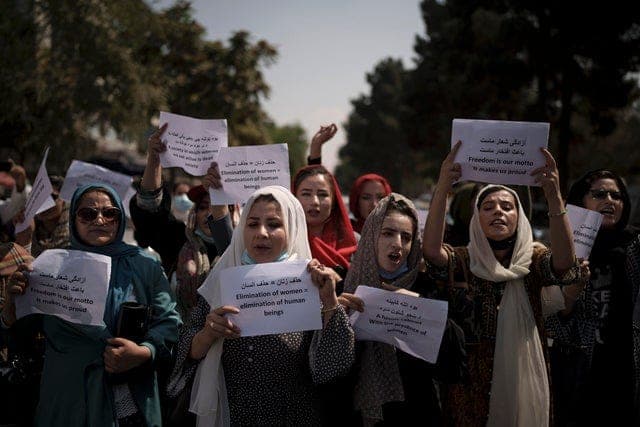
The Day Kabul Fell, Razia Was Carrying Her Books Razia was still a student when Kabul fell. She remembers the weight of her books in her hands more clearly than the sound of the city that day. Three of her school subjects were unfinished. The final exams were still ahead. Four years later, she remembers that moment not as history, but as interruption. She was studying in Kabul, far from her home in Badakhshan in north of Afghanistan, when everything collapsed. Fear moved faster than information. She did not know what would happen next—only that she needed to get home. She rushed through the streets, searching for a bus. None were running. Taxis were scarce. People were leaving, running, disappearing. She walked long distances with her books pressed to her chest, hoping to find transport. Halfway through her journey, a bus stopped. The rest of the way, she walked. When she finally reached home, she did not leave again for twenty days. She stayed inside, afraid of being captured, tortured, or kidnapped. That was what she had been told about the Taliban. Fear did not need proof—it only needed possibility. Later, she returned to Badakhshan, where she now lives with her family. Home should have felt safer. Instead, it felt smaller. She says she is afraid of going out—not only because of the Taliban, but because of a society that no longer sees her as fully human. Safety is not just about violence; it is about how people look at you, how they measure your worth. For a while, she tried to continue studying on her own. Books became companions. Silence became routine. Later, she found a small English language center. It was hidden. Quiet. Careful. To attend, she wore a burqa—a full-body covering. She accepted every restriction. Any hijab. Any condition. Education, she says, was worth it. She knew the risks. The center was operating quietly, away from attention. Still, it did not last. The Taliban discovered it. The center was shut down. The lecturers were arrested and taken to jail. That door closed too. Now, Razia spends most of her days at home. She cooks. She washes clothes. She sits with her parents. Sometimes she studies. Sometimes she plays games. Mostly, she says, “we just pass the days.” Time does not move forward. It circles. Many of her friends are gone. Some received scholarships. Some left with their families. When she talks about them, her voice carries both happiness and grief. “I also want to study,” she says. “I want to grow. I want to achieve my goals and help my country.” She looks at other girls like herself—girls at the age where life should be expanding, not shrinking. Instead, their lives are paused. Not by choice, but by force. At home, she feels lucky. Her father supports her. He never tells her to stay inside because she is a girl. That kind of support matters more than it sounds.
But outside the home, the world feels hostile. When she goes to the market to buy groceries, people stare at her as if she has no value anymore. As if her presence is inappropriate. Patriarchy, she says, is not just enforced by the Taliban—it is reinforced by society. Six months ago, she went out with her sister to buy hygiene supplies—things women need, things that are necessary. While they were inside the market, the Taliban entered. “They treated us very badly,” she says. “But you must stay silent.” Silence is not consent. It is survival. “When you step out of the house,” she says, “the disturbance starts.” She has watched underage marriage become common. Girls as young as fourteen, fifteen, sixteen are being married off. Some are her relatives. Their families see them as burdens. Marriage becomes the only acceptable future. They agree not because they want to, but because there is nothing else left to agree to. Razia’s life is not marked by one dramatic event. It is shaped by accumulation—of fear, restriction, waiting, and loss. Gender control does not arrive loudly. It settles into routines. It turns ambition into memory. She is still here. Still learning when she can. Still hoping quietly. And that, in a system designed to erase her, is its own form of resistance.