
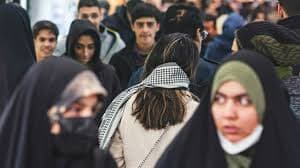
It Started as Obedience, Then Became Resistance For a long time, these restrictions felt normal to Mahsan. Not because they were fair, but because they were constant. Like many women, she learned to adapt. Over time, that adaptation turned into habit. But today, she says, it no longer feels the same. What changed was not a sudden freedom, but a slow shift in society. Alongside forced obedience, a quiet form of civil resistance began to grow. “Many women started with small things,” Mahsan tells me. Wearing slightly freer clothes. Ignoring informal warnings. Slowly changing what was considered acceptable in public spaces. None of it was loud, but together, it mattered. In her view, what happened over time was not acceptance of the restrictions, but a change in social norms. When large numbers of women made similar choices, strict enforcement became harder. “The law stayed the same,” she says, “but society began to move.” For Mahsan, this shift also became personal. From a certain point onward, her choices were no longer about full obedience or risky individual confrontation. They became conscious decisions—to move with a collective process. A way to share the costs, reduce the risks, and increase impact. “It wasn’t easy,” she says. “There were daily tensions and emotional pressure. But the progress was real.” Still, the anxiety did not disappear. Mahsan remembers how fear increased after she was summoned to a disciplinary committee for not fully complying with hijab rules. A warning from the head of security followed. “The stress didn’t come only from the law,” she explains, “but from not knowing what might happen next.” The possibility of being summoned again, forced to sign written commitments, or asked to explain deeply personal choices created constant pressure and anger. In public spaces, especially when the morality police were present, her reaction was immediate. “Normally I wasn’t anxious,” she says. “But when I saw them, my body reacted before my mind.” She would quickly adjust her clothing, becoming cautious without even thinking. The fear was not constant, but it appeared suddenly, in specific moments. What troubled her most was the uncertainty. “You never knew when or how you might be questioned,” Mahsan says. “Something completely normal for you could suddenly become a problem.” Despite all of this, she did not feel that her identity or personal worth was destroyed. She credits strong family support and a solid sense of self. But the experience taught her something early on: in Iranian society, being a woman comes with limitations. To exist in public spaces, you must constantly manage yourself—your body, your behavior, your visibility. Rather than weakening her, this awareness made her more resilient. “I learned that the problem was not me,” Mahsan says. “It was the structure.” This understanding helped her resist defining herself by imposed standards and strengthened her critical view of the system around her. Over time, she also realized that control goes far beyond clothing. These restrictions are rooted in legal, judicial, and cultural systems. They appear in laws about child custody, the value of a woman’s testimony in court, the right to leave the country, and institutions like the morality police—structures that clearly target women. Though imposed from above, their effects reach deeply into everyday life. The most dangerous consequence, Mahsan believes, is cultural. These laws create harmful attitudes—especially ideas linked to so-called “honor.” In this thinking, a woman’s clothing or personal relationships can be used to justify violence against her. Responsibility is taken away from the abuser and placed on the woman. This is where victim-blaming begins. When women face street harassment or sexual assault, instead of support, they are questioned about their clothing or their presence in certain spaces. Sometimes, the perpetrator is quietly excused.
From what Mahsan has seen and heard, imposed restriction is not just a law. It is a chain. It begins with legislation, moves into culture, and slowly settles into the public mindset. The result is a society that judges women instead of protecting them, and explains violence instead of preventing it. “This is the point,” Mahsan says, “where control becomes normal—and injustice starts to look like common sense.